

SIRGAS

Loading

SIRGAS

Category Capacitaciones 2023

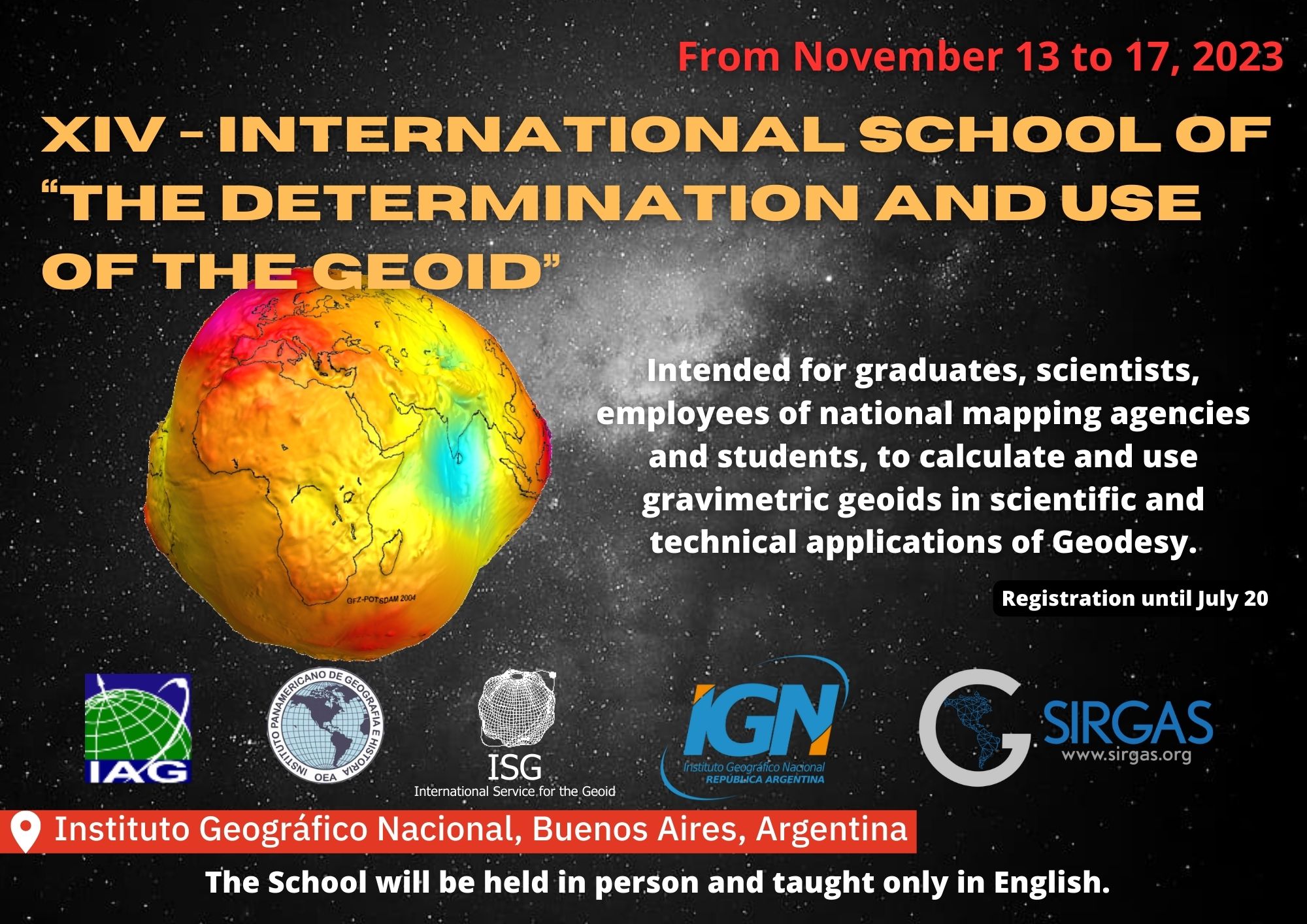
14th International School on “The Determination and Use of the Geoid”

From November 13 to 17, 2023 will be held the 14th International School on “The Determination and Use of the Geoid”. The School will take place at the Instituto Geográfico Nacional, in Buenos Aires, Argentina. The School will be held in person and taught only in English.

The general purpose of the full-week intensive Geoid School is to prepare new graduate students, young scientists, and employees of national agencies to compute and use gravimetric geoids for scientific and technical applications in Geodesy. In addition, the School provides an excellent opportunity to familiarize with the latest geoid determination development and improve international contacts and collaborations among scientists dealing with gravity field modeling.

In addition, the scientific community must be linked to the Cartographic Agencies responsible for implementing the GGRF in the country so that the research carried out in the scientific framework can be applied to develop regional and local regional geodesy.

The geoid school will be organized in cooperation with the International Service for the Geoid of the International Association of Geodesy

For better use of the knowledge that will be taught at the School, attendees must have a basic understanding of the following topics:

  • Concepts about gravimetric measurements and calculations
  • Concepts about altimetric measurements and calculations
  • Concepts on calculation and use of Digital Elevation Models

Concepts about Geopotential Models

A maximum of 30 attendees is planned, and registration requests were accepted from March 20th to July 20th, 2023.

Local Organizing Comitte


  • Surveyor Eng. Sergio Cimbaro (President IGN)
  • Cnel. Gustavo Caubarrère (President SIRGAS)
  • Dra. Daniela Carrion ISG, Politecnico di Milano)
  • Dr. Mirko Reguzzoni (ISG, Politecnico di Milano)
  • Dr. Gabriel Guimarães (UFU)
  • Dra. Claudia Tocho (UNLP)
  • Surveyor Eng. Hernán Guagni (IGN)
  • Cabo.2ª Laura Camacho (SIRGAS)
  • Surveyor Eng. Mariana Eiko (UFU)

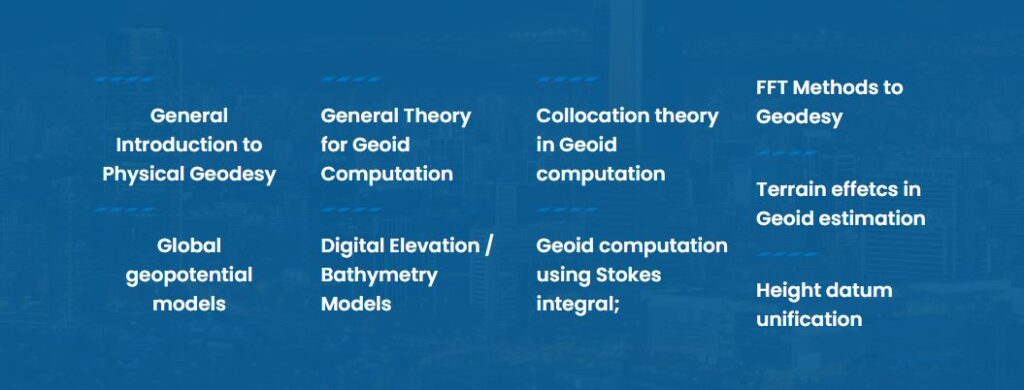
Main goals of the XIV – School
 

Venue of the XIV – Geoid School

The Venue of the XIV – School is the National Geographic Institute of Argentine Republic

Av. Cabildo 381, Ciudad Autónoma de Buenos Aires, Argentina (34,57171° S – 58,43944° O)

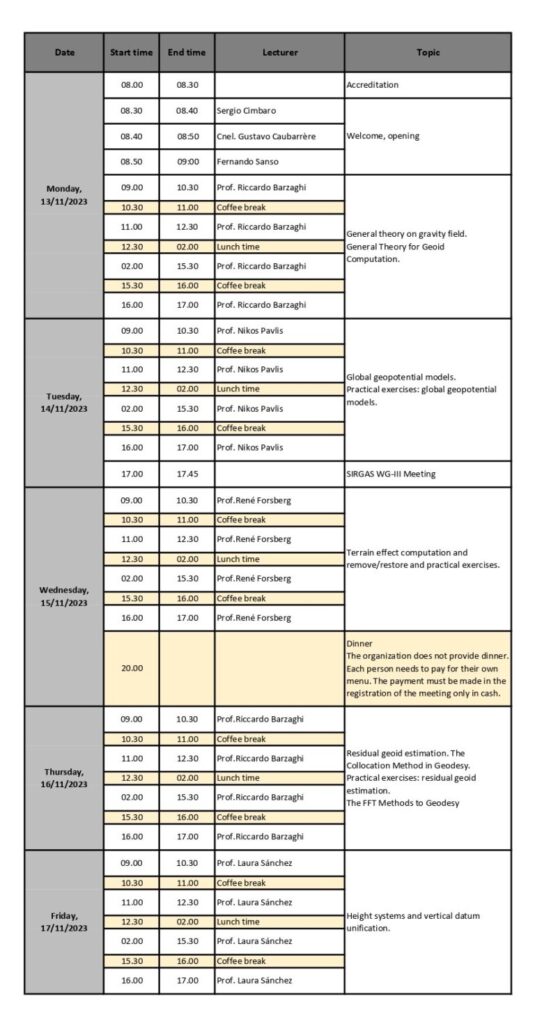
Sessions and preliminary program of the XIV – Geoid School
Facuty

  • Dr. Riccardo Barzaghi

Professor Politecnico di Milano


  • Dr. Nikolaos K. Pavlis

National Geospatial-Intelligence Agency – USA

  • Dr. Rene Forsberg

Professor National Space Institute (DTU-Space). Denmark

  • Dra. Laura Sanchez

DGFI-TUM

Deutsches Geodätisches Forschungsinstitut, Technische Universität München, Germany

Registration for the XIV – International School on The Determination and Use of the Geoid


Attendees

Registration for this event has now closed. We look forward to seeing you at the next event.

School places are limited. Priority will be given to participants working on the computation of gravimetric geoids and the unification of the vertical datum.

Once the pre-registration period has ended, a selection process will be carried out to determine who can attend the event. A confirmation will be sent to the selected participants via email or other contact method provided during pre-registration.

Attendees should have basic knowledge of the following topics:

  • Concepts of Physical Geodesy
  • Concepts on gravimetric measurements
  • Altimetric data concepts
  • Concepts on calculation and use of Digital Elevation Models
  • Concepts on Global Geopotential Models

Prior to school it is recommended to read the book:

Torge, W., & Müller, J. (2012). Geodesy. In Geodesy. From Gruyter.
8th SIRGAS School on Reference System

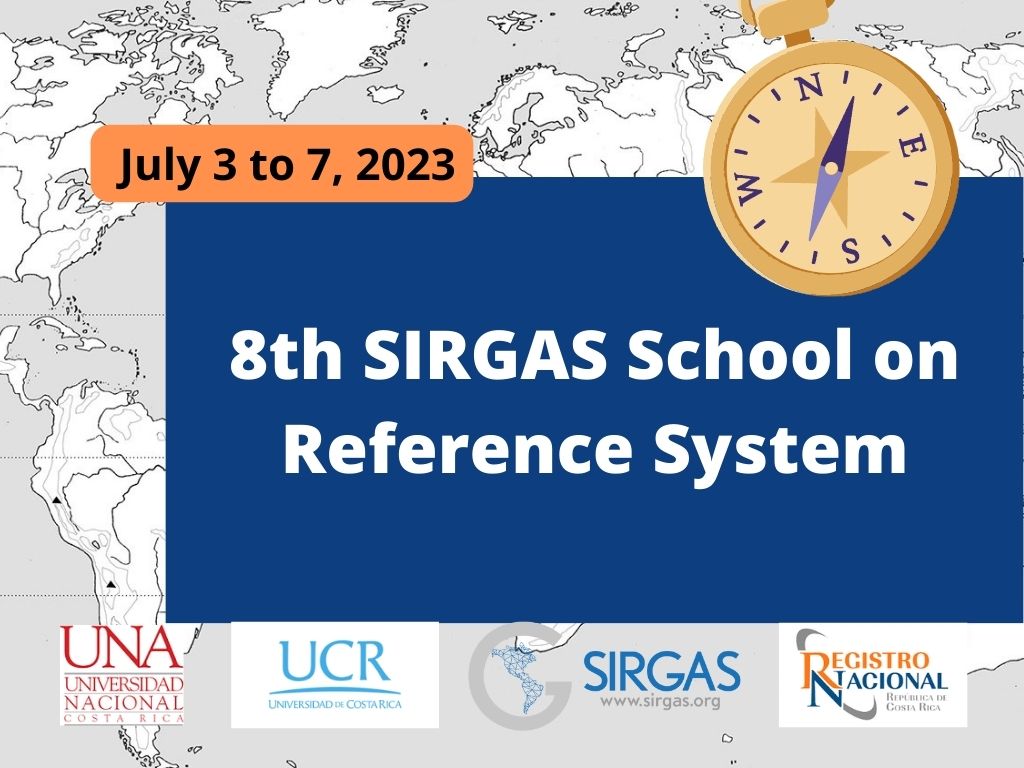
The 8th SIRGAS School on “Reference System” will be held from July 3 to 7, 2023. The School will take place at the University of Costa Rica and National University of Costa Rica, in San José and Heredia, Costa Rica. In this opportunity, attendance will be in person and the lectures will be in Spanish only.

This five-day course, which will cover the fundamental topics of physical and geometric geodesy, is aimed at advanced professionals, young scientists, and employees of national mapping agencies. The lectures will be divided into two blocks: theoretical (two and a half days) and practical (two and a half days). During the practical block, the instructor will impart topics on GPS/GNSS network processing and adjustment with BERNESE and GAMIT/GLOBK packages. By the end of the course, participants should be able to:

  • Know what metadata is necessary to process GNSS.
  • Understand the details of GNSS processing.
  • Set up a GAMIT/BERNESE process with your own data.
  • Use GLOBK/BERNESE to perform daily and weekly combinations.
  • Densify IGS20 using the sample data.
  • Know the theory taught during the first two and a half days.

Place:

School of Topography, Cadastre and Geodesy, Faculty of Exact and Natural Sciences, National University of Costa Rica, Theoretical classes. https://maps.app.goo.gl/yVPE2WdB6pEe6fyi6

School of Topographic Engineering, School of Engineering, University of Costa Rica, Practical classes, GAMIT/GLOBK and Bernese.

https://maps.app.goo.gl/sZFH2gkvuBHEEwyY7

Date:

3 – 7 July 2023

Organized by:

SIRGAS – Geodetic Reference System for the Americas. 

National Geographic Institute of Costa Rica.

School of Topographic Engineering, University of Costa Rica. 

School of Topography, Cadastre and Geodesy, National University of Costa Rica.

Organizing Committee:

Dr.-Ing. Mauricio Varela Sánchez (UCR)

M.Sc.-Ing. Robert Laurent Sanabria (UCR)

Ing. Álvaro Álvarez (IGN-CR)

MEd. -Ing. Gabriela Cordero Gamboa (UNA)

M.Sc. -Ing. Sara Bastos Gutierrez (UNA)

Contact: mauricio.varelasanchez@ucr.ac.cr

Lecturers: 

Prof. Dr. Gabriel Guimarães (Universidade Federal de Uberândia, Brazil) 

Prof. Dr. Demián Gomez (Ohio State University, Earth Sciences, USA)

Prof. Dr. José Antonio Tarrío Mosquera (Universidad Santiago de Chile, Chile)

Topics for theoretical part:

  1. Geodesy. Previous concepts and introduction 
  2. Definition.
  3. observation techniques.
  4. Reference surfaces.
  5. Latin American context. Geodetic singularities of the region.
  6. SIRGAS.
  7. Coordinate reference system. 
    1. Coordinate systems (definitions, existing coordinate systems).Cartesian coordinates [X, Y, Z, t].
      1. Ellipsoidal coordinates [lat, long, h].
      2. Local coordinates (topocentric) [e, n, u].
      3. Projected coordinates [E, N, H].
    2. Operations with coordinates (conversions and transformations).
  1. Reference Systems and Frame
    1. Generalities, Systems and Reference Frames (geodesic hierarchy, mathematical principles, definitions, System and Reference Frame and types of Systems (Celestial and Terrestrial)).
    2. Celestial Reference System and Frame, orientation and movements of the earth (ICRS, ICRF, precession, nutation, movement of the pole and terrestrial tides).
    3. Terrestrial Reference System (global (ITRS), continental (SIRGAS), definitions and realizations).
    4. Terrestrial Reference Frame (frame types according to movement, global (ITRF), continental (SIRGAS-CON)).
    5. Deformation models.
    6. Geodetic databases: ISO GR and EPSG.
  1. GNSS Positioning
    1. Introduction.
    2. GNSS structure.
    3. Reference Systems, Time and Reference Frames.
    4. Orbital theory.
    5. Observables.
    6. Mathematical models for positioning.
    7. Observation and processing.
      1. GNSS observations (baseline and sessions).
      2. Data and metadata (Rinex types, ephemeris types, rotation parameters, tidal files, ionospheric and tropospheric parameters, and antex file).
      3. Precision analysis (methodology).
    8. GNSS setting.
      1. Common setting (MMCC).
      2. Helmert transformation.
      3. Precision analysis (methodology).
    9. Consultation and discussion space.
  1. Vertical reference systems 
    1. Vertical Reference System.
      1. Vertical coordinate.
      2. Geometric system of heights.
      3. Components of the Geometric Vertical Reference System.
      4. Physical Heights System.
      5. Geopotential numbers and gravimetry.
      6. Reference Surfaces (ellipsoid, geoid and quasigeoid).
    2. System of existing heights.
    3. Modern vertical reference system.
      1. International Height Reference System (IHRS).
      2. Realization of the IHRS: IHRF International Height Reference Framework.
      3. Determination of coordinates in the IHRF.
      4. Contribution/integration of SIRGAS in the IHRS/IHRF.
      5. Advantages of using the IHRS/IHRF in the SIRGAS region.
      6. Immediate requirements for the establishment of the IHRS/IHRF in the SIRGAS region.

Topics for practical part:

In this section the concepts explained in the theoretical part will be taken, with the objective of optimizing the practical classes.

GAMIT/GLOBK 

  1. Initial Basics
    1. UNIX/LINUX philosophy.
    2. UNIX/LINUX file system structure.
    3. Command line.
    4. GAMIT-GLOBK Installation.
    5. Obtaining orbits and files necessary for GNSS data processing.
    6. GAMIT configuration files.
      1. site.defaults.
      2. process.defaults.
      3. sestbl.
      4. otl.list.
      5. autcln.cmd.
    7. GNSS metadata.
      1. station.info.
      2. APR (lfile).
      3. Earthquakes.
    8. GLOB-K: Combination of multiple daily networks.
    9. Updating tables for processing.
      1. How to invoke the sh_setup script.
      2. How to invoke the sh_gamit script.
      3. Evaluation of a result in GAMIT.
      4. Tropospheric parameters.
      5. Troubleshooting.
  1. Advanced Practical Concepts
    1. Practice.
      1. Processing of an example GNSS network.
      2. Introduction to GLOB-K.
      3. GLOB-K Configuration Files.
      4. Daily combination with GLOB-K.
    2. GNSS polyhedra stacking.
      1. Weekly mix of solutions.
      2. Time of measurement and conventional time.
      3. Solution aligned to IGS.
      4. Epoch-by-epoch alignment and stack alignment.

BERNESE 

This section will explain the basic concepts that support GNSS relative static processing performed in post-processing using double phase differences, for regional geodetic networks (similar to SIRGAS). The routine RNX2SNX.PCF will be used, with specific modifications.

  1. File structure and philosophy of SW BSW
    1. BSW Installation.
    2. Folder structure and data.
    3. Functional flow of the program. Routines.
    4. Directory structure and campaign settings.
    5. Nomenclature.
    6. Comparison between commercial and scientific SW.
  1. Processing through Double Differences (DD) of phase
    1. Input and output files.
    2. BPE variables (Bernese Processing Engine).
    3. Structure of the PCF (Process Control File).
    4. Creation of coordinates a priori.
    5. Preparation of polar and orbital information.
    6. Synchronization and conversion of data to BSW format.
    7. Baseline formation.
    8. Phase data filtering and preprocessing.
    9. Solution calculation of non-fixed ambiguities.
    10. Consultation and discussion space.
    11. Resolution of ambiguities.
    12. Calculation of network solution with fixed ambiguities
      1. Datum fix.
    13. Final files: tropospheric coordinates and delays.
    14. Consultation and discussion space.
    15. Use and combination of SIRGAS semi-free solutions.

A maximum number of 300 attendees for the theoretical classes and 45 attendees for the practical classes can be accepted.

Registrations have been closed, and those who pre-registered will receive a communication via email from the local organizing committee to confirm their participation.